
“Vietnam boasts amazingly varied landscapes;
from precipitous mountains to uncharted forests, from emerald terraced rice fields to deserted pristine beaches. It’s the best place in Southeast Asia to witness the convergence of the old and new is Vietnam. It shows the contrasting characteristics, from historical past to modern developments as well as diverse landscapes and people that will leave a lasting impression.
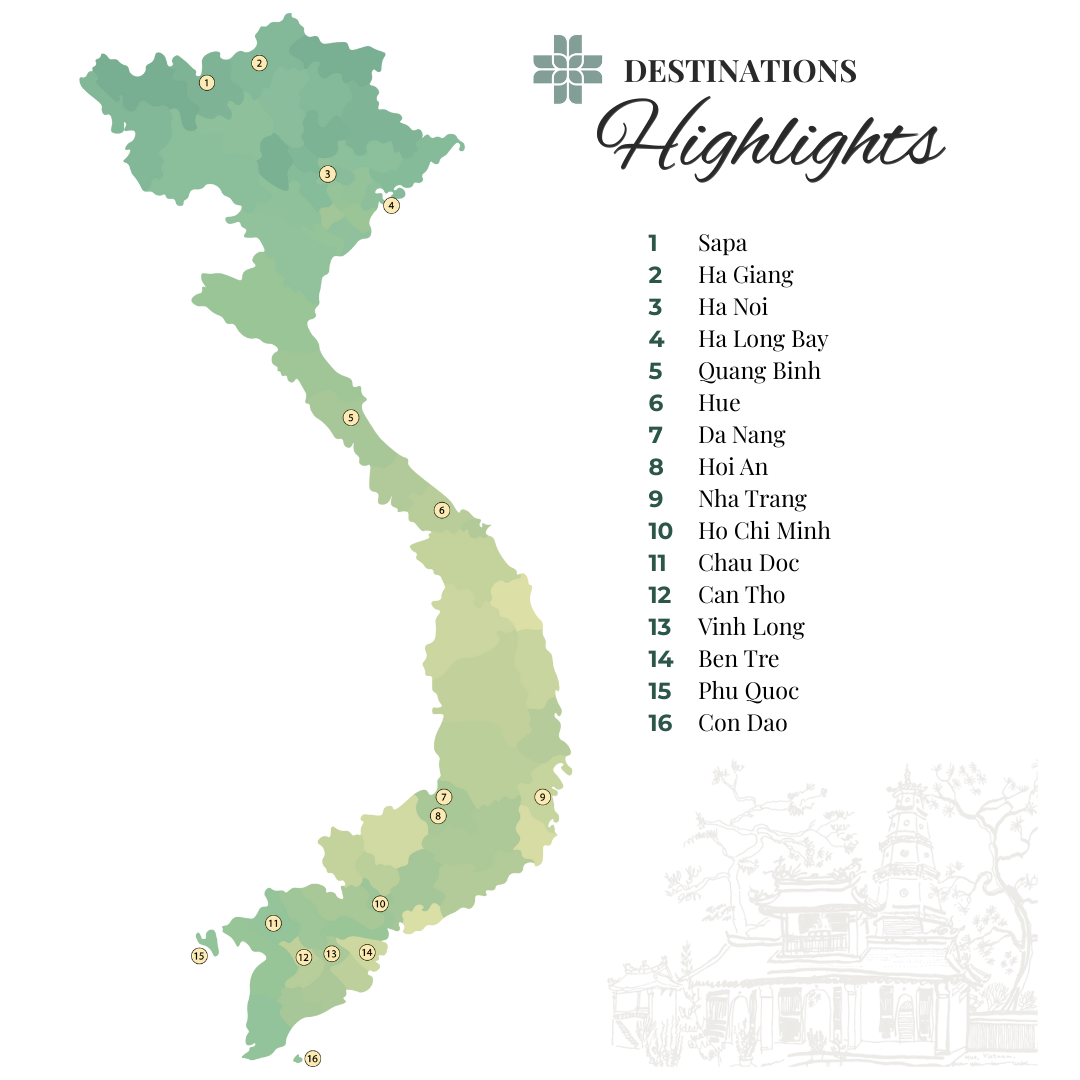
In general, Vietnam has a tropical climate with average annual temperatures ranging from 22˚C (72˚F) to 30˚C (86˚F). There are two distinct seasons: wet and dry. From April to October, most of the country is affected by south-western monsoons. The rains, which tend to be concentrated in the late afternoons, provide welcome relief to the heat. Travel to very remote areas may be affected by the rains, but overall they should not interfere with your trip.
Packing for a trip to Vietnam can be challenging, as the climate can vary depending on when and where you go. When the weather isn’t ideal in one area, it’s great in another. While Hanoi is cold enough to warrant a coat from December to February, this is an excellent time to visit Ho Chi Minh City and the Mekong Delta.Although the temperatures are consistent year round, various parts of the country, at certain times of the year, can be affected by unpredictable storms which may cause flooding.
Northern Vietnam (Hanoi, Ha Long Bay, Ninh Binh, Mai Chau, Sapa, Cao Bang, Ha Giang):
The north is defined by four seasons with a cold winter and hot summer. The temperature can range from 5˚C (41˚F) in winter up to 35˚C (95˚F) in the summer. From April to October, it is generally warm and humid with average temperature around 31˚C (90 ˚F) and heaviest rainfall between July and August. The average temperature during the cold season (December to February) is 20˚C (68˚F). However, in the mountainous regions in the far north such as Sapa, the temperature can at times drop below zero (32˚F). The loveliest time of the year to visit is from September to December when there’s a good chance of clear skies and low humidity.
The average annual temperature in the provincial city of Ha Giang & Cao Bang is 22.78 °C (73.00 °F); the monthly averages range from a low of 15.48 °C (59.86 °F) in January to a high of 27.88 °C (82.18 °F)C in July. The rain season is from June to August. The best time of the year to visit these areas is from September to November.
Central Vietnam (Hue, Danang, Hoi An, Quy Nhon, Phu Yen) and Central highlands (Da Lat, Buon Me Thuot, Kon Tum)
The average high temperature in the central region is 30˚C (86˚F). Heavy storms and highest amount of rainfall occurs from October to November and is prone to flooding. The best time to enjoy the beach weather and cultural sightseeing is between March till early October.
The central highland town of Dalat has a year-round temperate of 18˚C to 21˚C (64˚F to 70˚F) earning it the epithet “City of Eternal Spring”. The rainy season of Buon Ma Thuot lasts mostly from May to October of a year. Buon Ma Thuot is warmer and more humid because of its lower elevation.
Southern Vietnam (Saigon, Mekong Delta, Phu Quoc island):
The south has a dry and rainy season. The highest amount of rainfall is from June to October with 80% average humidity. The average high temperature year round is 32˚C (90˚F). Beach destinations such as Nha Trang, Phan Thiet, and Phu Quoc Island are warm and sunny most of the year. However, the rainy season varies for each destination: Nha Trang (October to December); Phan Thiet (July to November); and Phu Quoc (May to October).

1. How to book a tailor-made tour with Justravel Asia?
Justravel Asia is a ground tour operator specialized in tailor-made travel itineraries base on your interests. We don’t sell group tours, we use our 20 years of combined travel experience to pick the accommodation and activities, create cultural-rich journeys with local insight.
Feel free to drop an email request to either Han (han.pham@justravelasia.com) or Alice (tu.luu@justravelasia.com) – the Co-founders, don’t forget to give some hints about your special interests. They will get in touch with you shortly to discuss over the travel plan and then get back to you with detailed itinerary and prices. We welcome your opinions to modify the itinerary until it fits your dream trip.
2. Do you need a visa to travel to Vietnam?
As officially announced, as of 2023, citizens of 25 countries can travel to Vietnam and remain in the country for 14 to 45 days (depending on nationality) without having to apply for a visa. Those countries include Southeast Asia countries, Scandinavia, Finland, France, Italy, German, UK, Spain, Japan, South Korea, Chile and several Central Asia countries.
Other foreign nationals can apply for electronic visas (E-visas) on the Vietnamese Immigration Department’s website. For a fee of $25 for one entry or $50 for multiple entries, payable via bank transfer, you can obtain an e-visa which is valid for up to 90 days. All 42 international border checkpoints, including airports, are accessible to holders of electronic visas for entry and leave into Vietnam.
You can visit Vietnam Immigration Department website for official details:
3. How long should you travel to Vietnam for your first time?
A classic trip to Vietnam should take at least 10 days to cover the top attractions. You can start from either Hanoi or Saigon, where most of international flights arrive, then continue to visit other parts such as UNESCO Heritages Ha Long Bay and Hoi An ancient town. Full day trip to Mekong Delta to experience the wet rice culture would be nice enough. Apart from natural landscapes and historic town, Vietnamese cuisine is ranked as one of the must-try with its freshness and creative recipes, thus, a food tour is always recommended, whether on foot or by motorbike.
4. How much money should you bring to Vietnam, Cambodia and Laos?
Comparing to other countries in Southeast Asia, Vietnam, Cambodia and Laos are more affordable. The living cost in big cities like Hanoi, Da Nang, Saigon, Phnom Penh and Siem Reap are obviously a little higher comparing to the rest. Let’s say, in these cities, you can get a big bowl of Cambodian noodles at $2.5, a loaf of Vietnamese banh mi at $1.5, while in the countryside, $1 street food is still available. Of course, there are dining places that costly, but in general, an average budget of $25 per day for transfer and local food will be enough. It actually depends on how much you want to spend and how adventurous you are for food and accommodation.
5. Are there luxury hotels in Vietnam, Cambodia and Laos?
Eventhough Indochina has become popular destinations in the past 10 years, surprisingly we have most of top luxury international hotel brands, from Hilton, Hyatt, Accor and Marriot to Six Senses, Aman, Bayan Tree, Four Seasons and such. Some hotels and resorts are famous not only for top notch service but also for their unique design, such as Bensley projects.
6. Is Vietnam, Cambodia and Laos safe for solo travelers and female travelers?
There is nothing 100% but we are sure that we welcome all types of travelers. Crimes happen here and there anywhere in the world, but with our consistency in politics, we ensure social security. Vietnam also respect women and we even put more effort in supporting female travelers.
Justravel Asia has proudly welcomed many solo female travelers. We are a female-run business so we understand their concerns and has successfully turned it to happiness at the end of the trips.
7. Is Vietnam a good destination for family trip?
Vietnam offers variety of activities for kids and teenagers. We have mountains and caves for outdoor adventurous trek and hike, beach for sea sports, and most of all, we have rich culture and traditions for them to learn. Your kids can experience making traditional crafts, trying to ride on buffalo to plough on rice fields, or learn how to help local community through sustainable activities. Are your kids so addicted to fast food? Don’t worry, Vietnamese cuisine with fresh ingredients and less spices can accommodate their appetite. With above reasons, it is no doubt that Vietnam is a perfect destination for family vacations.
8. Is it true that Vietnam is a gay friendly destination?
Defintely! Eventhough same sex marriage is not officially recognized, all 3 countries Vietnam, Cambodia and Laos are welcoming gay travelers as much as other travelers. We are lucky that our society is becoming more opened, in the fastest way ever! In big cities, gay couples feel comfortable hanging out hands in hands. Of course, to some elderly parents, same sex marriage is not fully acceptable, but in general, LGBTQ community is growing with lots of campaigns to get recognized. We have many gay friendly hotels/resorts where some gay weddings were held.
Justravel Asia is proud to be the first DMC in Vietnam to officially promote LGBTQ travel, we respect diversity within the team, and have LGBTQ guides to take care of our clients.
Visa requirements:
- Most nationalities must have a visa to enter Vietnam with exception of some Asian nationals.
- From Jan 1, 2015, tourists from Russia, South Korea, Denmark, Norway, Sweden and Finland whose temporary stay in Vietnam is less than 15 days are eligible for a visa waiver.
- Until June 30, 2017, tourists from France, Germany, UK, Italy, Spain, Korea, Japan, Norway, Finland, Sweden, Denmark and Russia can travel for 15 days visa-free. According to this circular, those EU citizens can have single entry visits up to 15 days and in case they would like to enter Vietnam again with visa exemption
Vietnam Visa on Arrival:
Please note that Visa-on-Arrival works only for visitors arriving in Vietnam by air. If you arrive in Vietnam by land or cruise, you need to apply for a visa in advance at the Vietnamese Embassy or Consulate in your country.
To arrange for a visa on arrival available only at Ho Chi Minh City (Saigon), Danang and Hanoi airports, please send us the following information:
- Arrival date with arrival airport information
- Passport copy
- Travelers who get visa on arrival need to bring along as least 2 passport photos (size 4×6 with white background) and USD 25 per person (in cash) for stamping fee .
It normally takes 3 business days to secure a Visa Authorization Letter, which Justravel Asia will email the scanned copy to you. You must present this letter when boarding your inbound flight to Vietnam. The effective date will be mentioned in the approval letter. You are not allowed to enter Vietnam before the authorized date of entry. In urgent cases, we may be able to arrange a visa on arrival more quickly, but we cannot guarantee this. (Countries in Africa and Middle East along with India and Turkey require an additional letter to be filed for Visa on Arrival. Therefore please allow 2 additional weeks for processing.)
It is a requirement to provide Justravel Asia with your full passport and visa information prior to entering Vietnam. Please make sure your passport is valid more than 6 months from the date of departure of each country you are visiting. Also, make sure you have enough blank pages – you may need up to 1.5 pages for each country you visit in Southeast Asia.
Vietnam E-Visa:
E-visa is granted by Vietnamese Immigration Department to enable some countries to apply for a visa online. You can find the list of countries that are eligible for e-visa on the National Web Portal on Immigration. Here’s a link to read more www.evisa.xuatnhapcanh.gov.vn/en_US/trang-chu-ttdt
To apply for e-visas, foreign citizens can access the websites:
- http://www.xuatnhapcanh.gov.vn
- http://www.immigration.gov.vn
- https://evisa.xuatnhapcanh.gov.vn/en_US/web/guest/trang-chu-ttdt.
Applicants are required to complete a form available on two separate websites (one in Vietnamese and the other in English) run by the Ministry of Public Security. They will receive an application code and will be asked to pay a non-refundable fee online.
It will take three working days for tourists to find out if their applications have been approved or not, according to the directive. But we recommend you to proceed with visa at least 3 weeks in advance, in case immigration system encounters errors. Successful applicants will be able to print off their e-visas to present when they arrive. Visitors can touch down at any of Vietnam’s eight international airports, including Tan Son Nhat in Ho Chi Minh City, Noi Bai in Hanoi and Da Nang in the central region. They can also arrive via land at 13 international border gates, and via sea at seven ports across the country.
Insurance:
Travelers are highly recommended to purchase trip and travel insurance. Trip insurance covers the cost of your trip should you be forced to cancel your trip before you start the trip. Travel insurance covers such costs as emergency and medical evacuation, hospital fees, property loss, etc. which could possibly happen during the trip. If you would like Justravel Asia have a copy of your travel in assurance information in case of emergency, please forward these details to your agent who will in turn forward to our office.
Health:
Please consult your doctor to discuss your particular health or immunization requirements. If you would like to have a source of further information, please refer to the Center for Disease Control (CDC) website at www.cdc.gov
Money:
Vietnam’s currency is the Vietnam Dong (VND). The best place to change your money is in your hotel. Many banks (open Monday to Friday) issue cash advances for Visa and MasterCard, usually for a 3% commission. Credit cards and travelers’ checks are accepted in big cities although ATMs are widely available throughout Vietnam and this is the easiest and safest way of accessing money.
The exchange rate is around VND 23,000 to the US Dollar (check www.xe.com for the latest exchange rate).
Mobile Phone:
Your guide can assist you to purchase a local SIM card and/or hand set at any mobile phone shop. ‘Top up’ credit vouchers are available at most phone shops, particularly ones displaying the network logo, or local post offices. You can place international phone calls and send faxes at post offices or at most hotels, although hotels often charge extra fees.
Internet:
Wireless (Wi-Fi) Internet access is available in most hotels throughout Vietnam and free wifi is available in many restaurants, cafes and bars. Be careful to not save your password or sensitive information on public computer terminals.
Electricity:
Most of the electrical current in Vietnam is 220V, 50Hz. Round two-plug pins are more common although some places use flat pins or three-pronged pins. Adaptors are sold in local markets and usually available from your hotel. Protect you sensitive electronic equipment like laptops from power fluctuations by using a surge-protector.
Clothing:
If your trip to Vietnam includes stops at beaches and mountainous areas, you will need clothes for all temperatures. A swimsuit, sunglasses, a hat, t-shirts, shorts that are not too revealing, long trousers, some light-weight, long-sleeved tops and a light jacket that is wind and rain-resistant will get you through most trips. If you plan to visit northern Vietnam in the winter, you’ll need a warm coat. Mountainous areas can get chilly; choose clothes you can layer.
If trekking is on your agenda, you will need sturdy footwear with traction—plus lots of socks. Slip-on shoes or sandals are useful for visits to pagodas or people’s houses, as you’ll save time taking your shoes on and off.
Larger cities like Ho Chi Minh City and Hanoi offer upscale bars and restaurants, so be sure to pack some clothes and shoes for a nice evening out. It’s not advisable to bring your flashy jewelry.
Travel documents:
Bring a money-belt to safely carry your travel documents and cash, and ensure that your luggage has a lock. Bring photo-copies of your passport and visa, plus some extra passport-sized photos if you’re applying for on-arrival visa (just in case). When flying into or within Vietnam, you will probably be given baggage claim tags (they might be stuck to the back of your ticket). Keep these, as you will need to show them when leaving the airport.
Tipping
While not compulsory, tipping is greatly appreciated throughout Southeast Asia, especially in
the service industry, when you are pleased with the services provided. For reference, we have
provided a general guideline below:
- Guides (>4 travellers): $10-$15 per day per traveller
- Drivers (>4 travellers): $5-$7 per day per traveller
- Guides (<5 travellers): $5-$10 per day per traveller
- Drivers (<5 travellers): $3-$5 per day per traveller
- Restaurants: 10-15% of the total bill
- Hotel Maid Service: $2 – $3 per day
- Porters: $2 – $3 at time of service
- Local Boat Transport: $5 – $10 per boat
- Overnight Cruise: $5 – $10 per night per traveller (to cover all crew)
Water
It is advisable not to drink water from the tap unless it is boiled properly.
Medical
The standard of medical facilities within Vietnam varies. International care facilities can be found in the major cities of Hanoi, Ho Chi Minh and Danang. Facilities in public and rural hospitals are well below international standards and medical evacuations to a major centre may be required even for a relatively small injury. If a problem arises where you are in need of medical attention, the best option is to visit an international clinic. Please contact your hotel or guide for information on clinic services and to find one that is appropriate for Western visitors.


