
“Once the greatest empire in Southeast Asia,
Cambodia’s colorful history and awe-inspiring sites make it one of the most exciting countries in the region to visit. Cambodia, with the ancient archaeological ruins of Angkor, a UNESCO World Heritage Site, the virgin forests, waterfalls, and remote hill-tribe villages in the northeastern provinces, is a raw, alive, beautiful and challenging destination that bring you a feeling of being a part of its mysterious history.
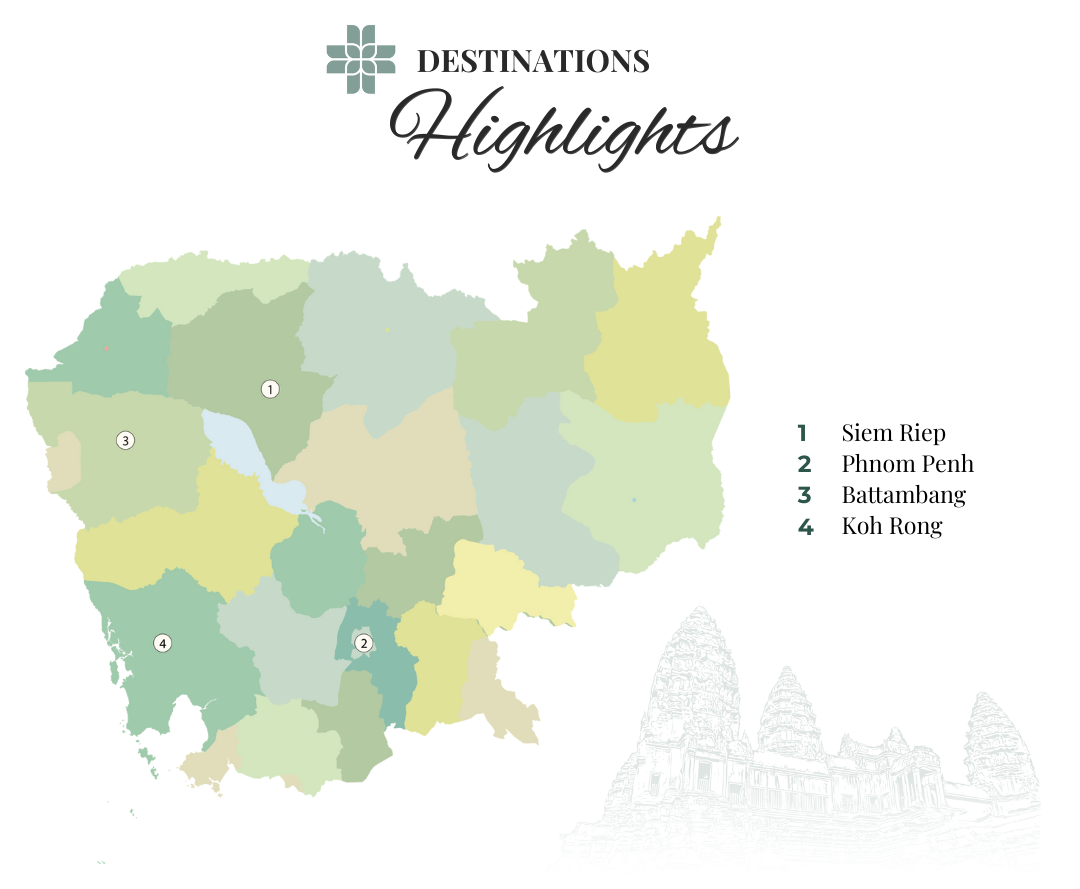
Cambodia has a tropical climate that is warm and humid with two distinct seasons: rainy season and dry season. During the peak of the rainy season (June to August), the humidity is higher and the temperatures can reach the upper 30°C (86°F), From September to early November, it is wet and slightly cooler. Seasonal flooding in Phnom Penh and the rest of Cambodia occurs in September and October which may cause disruption to travel. The dry season (November to May) is pleasant from November to February and becomes hotter from March to May, where temperatures can soar as high as 38C (100F).
At the end of the summer one of Cambodia’s true wonders comes to life — The Tonle Sap, the largest freshwater lake in Southeast Asia and home to Cambodia’s floating villages

1. How to book a tailor-made tour with Justravel Asia?
Justravel Asia is a ground tour operator specialized in tailor-made travel itineraries base on your interests. We don’t sell group tours, we use our 20 years of combined travel experience to pick the accommodation and activities, create cultural-rich journeys with local insight.
Feel free to drop an email request to either Han (han.pham@justravelasia.com) or Alice (tu.luu@justravelasia.com) – the Co-founders, don’t forget to give some hints about your special interests. They will get in touch with you shortly to discuss over the travel plan and then get back to you with detailed itinerary and prices. We welcome your opinions to modify the itinerary until it fits your dream trip.
2. Do you need a visa to travel to Cambodia?
Cambodia eVisa is an online visa implemented by the Cambodian authorities in 2016. The Cambodian eVisa is valid for 90 days from the date of issue and allows a single-entry permit with a maximum stay of 30 days in the country. The electronic visa for Cambodia can only be used for one entry into the country. If you plan on visiting Cambodia again, you will need to apply for a new visa.
You can visit Cambodia Immigration Department website for official details:
3. How long should you travel to Cambodia for your first time?
Cambodia has so much to discover, but if you have limited time, 7 days would be ideal to explore this former Khmer Kingdom. You can fly in to Cambodia’s capital – Phnom Penh, spend 2-3 nights here for a glance of modern Cambodia and the history of Khmer Rouge. Then you can take 6-hour drive or fly to Siem Reap. It is no doubt that Siem Reap is one of those places that caters to every taste. Besides the legendary Angkor temples, the variety of cuisine, accommodation, shopping, modes of transport, and daily activities is quite astonishing for what is actually a relatively small – and new – city on the edge of the Tonle Sap lake.
4. How much money should you bring to Vietnam, Cambodia and Laos?
Comparing to other countries in Southeast Asia, Vietnam, Cambodia and Laos are more affordable. The living cost in big cities like Hanoi, Da Nang, Saigon, Phnom Penh and Siem Reap are obviously a little higher comparing to the rest. Let’s say, in these cities, you can get a big bowl of Cambodian noodles at $2.5, a loaf of Vietnamese banh mi at $1.5, while in the countryside, $1 street food is still available. Of course, there are dining places that costly, but in general, an average budget of $25 per day for transfer and local food will be enough. It actually depends on how much you want to spend and how adventurous you are for food and accommodation.
5. Are there luxury hotels in Vietnam, Cambodia and Laos?
Eventhough Indochina has become popular destinations in the past 10 years, surprisingly we have most of top luxury international hotel brands, from Hilton, Hyatt, Accor and Marriot to Six Senses, Aman, Bayan Tree, Four Seasons and such. Some hotels and resorts are famous not only for top notch service but also for their unique design, such as Bensley projects.
6. Is Vietnam, Cambodia and Laos safe for solo travelers and female travelers?
There is nothing 100% but we are sure that we welcome all types of travelers. Crimes happen here and there anywhere in the world, but with our consistency in politics, we ensure social security. Vietnam also respect women and we even put more effort in supporting female travelers.
Justravel Asia has proudly welcomed many solo female travelers. We are a female-run business so we understand their concerns and has successfully turned it to happiness at the end of the trips.
Visa requirements:
Most nationalities are eligible for a one-month visa-on-arrival at Phnom Penh airport or Siem Reap airport, and at land borders. The cost is US$30 for a tourist visa and US$35 for a business visa, with a US$2-4 sometimes charged to cover administration fees. Bring payment in US dollars and one passport photo. Please be aware that sometimes there can be long queues at the airport when obtaining a visa-on-arrival, however in general the queues move fairly quickly.
You can apply via the official website of the Ministry of Foreign Affairs of the Kingdom of Cambodia (http://evisa.mfaic.gov.kh/) to obtain an electronic visa
Even when organizing your own visa from home or other countries, it is a local requirement to provide Justravel Asia with your full passport and visa information prior to entering Cambodia. This is also applicable for the airlines to issue the air-ticket and for the hotels to prepare the check-in procedure.
Please make sure your passport is valid more than 6 months from the date of departure of each country you are visiting. Also, make sure you have enough blank pages – you may need up to 1.5 pages for each country you visit in Southeast Asia.
The following countries are not eligible for visa-on-arrival: Afghanistan, Algeria, Saudi Arabia, Bangladesh, Iran, Iraq, Pakistan, Sri Lanka, Sudan, Nigeria. For these countries, they must arrange the visa in their home countries before arrival.
Insurance:
Travelers are highly recommended to purchase trip and travel insurance. Trip insurance covers the cost of your trip should you be forced to cancel your trip before you start the trip. Travel insurance covers such costs as emergency and medical evacuation, hospital fees, property loss, etc which could possibly happen during the trip. If you would like Justravel Asia to have a copy of your travel insurance information in case of emergency, please forward these details to your agent who will in turn forward to our office.
Health:
In general, health requirements for Cambodia are little different to most destinations. Please consult your doctor to discuss your particular health or immunization requirements. If you would like to have a source of further information, please refer to the Center for Disease Control (CDC) website at www.cdc.gov
Money:
Cambodia’s currency, the Riel (Real), exchanges at a rate of about 4,000 to the US Dollar. However, the US Dollar has become the country’s common currency and Riel notes are used for fractional dollar amounts as U.S. coins are not in circulation. Bring clean bills in small denominations ($1 and $5) for making purchases. Credit cards are widely accepted in most hotels, major restaurants and large shops in Phnom Penh and Siem Reap. Outside of these they are rarely accepted. Do not accept torn or worn US$ notes as change as you will have problems spending them. Travellers cheques are no longer accepted in Cambodia (the only exception being ANZ Royal Bank branches, but the transaction can be lengthy).
Many banks (open Monday to Friday) issue cash advances for Visa and MasterCard, usually for a small commission. Credit cards are accepted in the cities although ATMs are widely available throughout Cambodia (dispensing USD) and this is the easiest and safest way of accessing money. When traveling to the countryside, VISA card can get you money at ACLEDA Bank, which is in every provincial capital.
Mobile Phone:
Your guide can assist you to purchase a local SIM card and/or hand set at many mobile phone shops. ‘Top up’ credit vouchers are available at most phone shops, particularly ones displaying the network logo. You can place international phone calls and send faxes at most hotels, although hotels often charge extra fees
Internet:
Wireless (wi-fi) Internet access is available in most hotels throughout Cambodia and free wifi is available in many restaurants, cafes and bars. Be careful to not save your password or sensitive information on public computer terminals.
Electricity:
Electricity in most of Cambodia is 220V, 50Hz. Electric power sockets generally fit two round pins. Three-pin plug adapters are usually provided by deluxe hotels. In all countries, protect sensitive electronic equipment like laptops from power fluctuations by using a surge-protector.
Clothing:
Since the weather is consistently warm throughout the country, it is advisable to bring comfortable lightweight, loose fitting, cotton clothing and long-sleeved items for protection from mosquitoes and the sun.
During the rainy season, an umbrella and open-toe sandals are recommended. Cambodia is a very casual country and a lightweight jacket may only be needed in the more upmarket hotels and restaurants using excessive air-conditioning. A hat and high-factor sun block is advisable for protection against the hot sun when sightseeing. T-shirts and knee length shorts are acceptable for visiting temples or pagodas, including those of Angkor Wat. Shoes are generally removed at the entrance to pagodas.
For visits to the Silver Pagoda, which is within the Royal Palace grounds, visitors are advised to wear long trousers or long skirts. At the Angkor complex, you’ll be on your feet and walking a lot, sometimes over rough and slippery surfaces, so choose your footwear carefully. The soles of your shoes should offer good traction.
Travel documents:
You should bring a money-belt to safely carry your travel documents and cash, and ensure that your luggage has a lock. Bring photocopies of your passport and visa, plus some extra passport-sized photos if you’re applying for on-arrival visas. When flying into or within Cambodia, you will probably be given baggage claim tags (they will be stuck to the back of your ticket). Keep these, as you may need to show them when leaving the airport.
Tipping
While not compulsory, tipping is greatly appreciated throughout Southeast Asia, especially in the service industry, when you are pleased with the services provided. For reference, we have provided a general guideline below:
- Guides (>4 travellers): $10-$15 per day per traveller
- Drivers (>4 travellers): $5-$7 per day per traveller
- Guides (<5 travellers): $5-$10 per day per traveller
- Drivers (<5 travellers): $3-$5 per day per traveller
- Restaurants: 10-15% of the total bill
- Hotel Maid Service: $2 – $3 per day
- Porters: $2 – $3 at time of service
- Local Boat Transport: $5 – $10 per boat
- Overnight Cruise: $5 – $10 per night per traveller (to cover all crew)
Water
It is advisable not to drink water from the tap unless it is boiled properly.
Medical
Medical care has come a long way in Cambodia, though it is still lacking in comparison to its more developed neighbours. In the event of serious injury, evacuation is necessary. For minor injuries, the Royal Rattanak General Hospital in Phnom Penh, the Royal Angkor in Siem
Reap and the newly opened Sonja Kill Memorial Hospital in Kep are acceptable. Outside the major cities of Phnom Penh and Siem Reap, local hospitals are far below international standard and should be avoided. However, pharmacies can be found throughout the country but may lack certain medications and may only sell generic brands of common medicines.
Should you need medical assistance while travelling in Cambodia, please inform your guide.


